
Search Delaware Traffic Ticket Records
Delaware traffic ticket records are official court documents created when a driver receives a citation for a traffic offense anywhere in the state. The Justice of the Peace Court handles most traffic violations across New Castle, Kent, and Sussex counties. You can search these records through the Delaware CourtConnect portal, request copies at the court where the case was filed, or check your violation history through the Delaware Division of Motor Vehicles. This page covers where to find Delaware traffic ticket records, how to pay a citation, and what to expect when dealing with the state's traffic court system.
Delaware Traffic Records at a Glance
How Delaware Handles Traffic Ticket Records
The Delaware court system processes more than 300,000 cases each year across all court types. For most traffic offenses, the process starts at the Justice of the Peace Court. JP Courts operate across all three counties and have original jurisdiction over traffic violations, including offenses by 16 and 17-year-old drivers. These courts handle everything from speeding citations to more serious misdemeanor traffic charges. Most people dealing with a traffic matter will encounter the court system here first.
The Court of Common Pleas sits above the JP Court in the state's judicial hierarchy. It handles misdemeanor cases, civil disputes up to $50,000, and serves as an appeals court for traffic matters that come up from JP Court. In New Castle County, the Court of Common Pleas Traffic Court combines arraignment and trial into a single court appearance, which speeds up the process considerably. Motorists convicted at JP Court can transfer their cases to the Court of Common Pleas except for DUI violations and driving after judgment prohibited. The Records Custodian for the Court of Common Pleas Traffic Court is at the Leonard L. Williams Justice Center, 500 North King Street, Wilmington, DE 19801.
Alderman's Courts operate in several Delaware cities and handle municipal ordinance violations and local traffic tickets within city limits. These courts are independent of the state judicial system but operate under city charters approved by the General Assembly. Appeals from Alderman's Courts go de novo to the Court of Common Pleas within 15 days of trial, meaning the case is heard fresh as if the first proceeding never happened.
Traffic ticket records include the violation charge, hearing date, court location, docket entries, and the final outcome of the case. Each court level keeps its own files, so the documents you need depend on where the case was heard.
Records from JP Court, the Court of Common Pleas, and Superior Court are each maintained separately and accessed through different offices depending on the level of the case.
The Delaware Courts website gives you direct access to pay traffic tickets, search civil case records, and find court locations statewide.
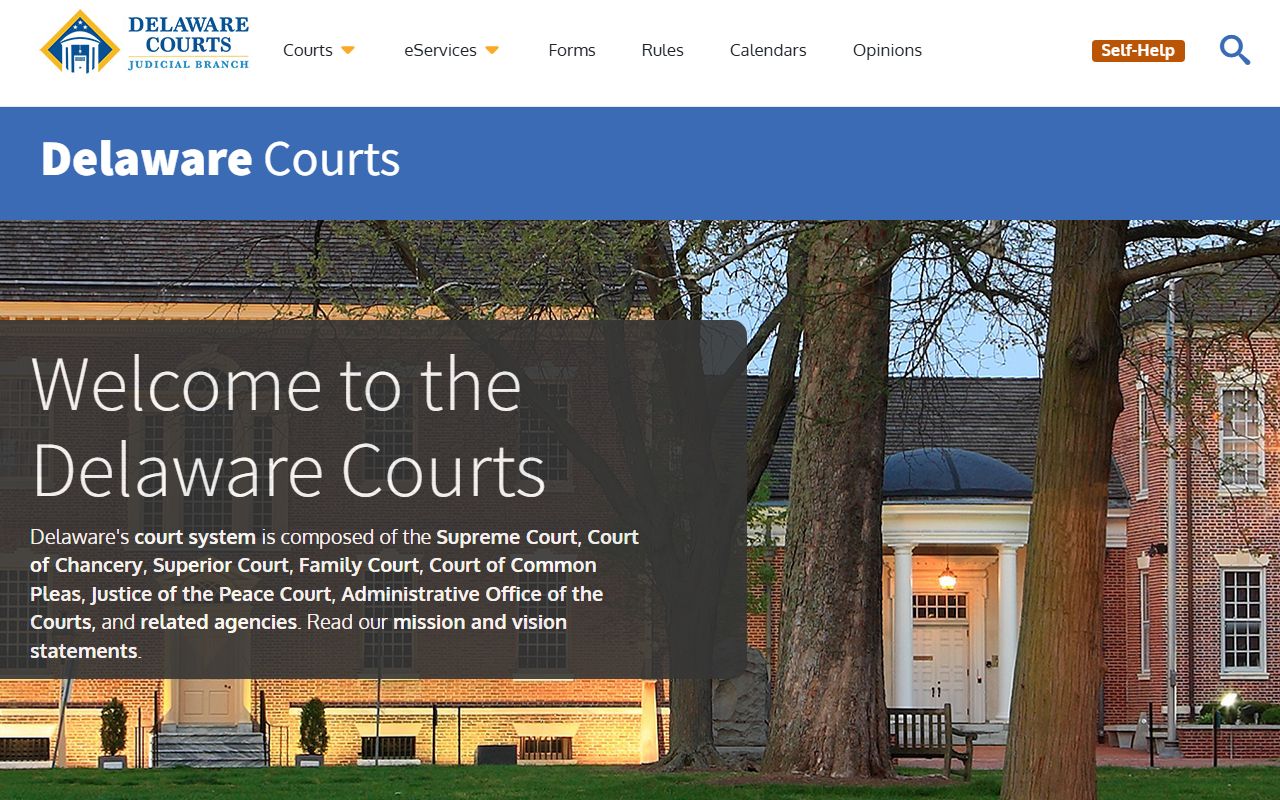
From this site you can also reach the e-payment system and find information on procedures for each level of the court system.
Search Traffic Ticket Records with CourtConnect
CourtConnect is the Delaware Judiciary's online portal for civil case information. It gives the public access to cases from the Superior Court, Court of Common Pleas, and Justice of the Peace Court. For traffic cases, CourtConnect covers civil traffic violation proceedings. You can search by party name, business name, or case type. Results show party names, case status, hearing dates, docket entries, and judgment information. You can generate a docket report once you find the case you're looking for.
To search, go to courtconnect.courts.delaware.gov and enter a first and last name or a business name. Searches can be filtered by date range using the filing date. Basic searching is free and doesn't require an account. Registration gives enhanced access for users who need to track multiple cases. CourtConnect does not show criminal traffic records. For those, you need to contact the appropriate court in person, by mail, or by email. Some criminal traffic cases from Justice of the Peace Court are available online and can be found by searching the defendant's name, with case details appearing once you click a linked case number.
CourtConnect is the main free tool for searching civil traffic case records across all three Delaware counties without a courthouse visit.
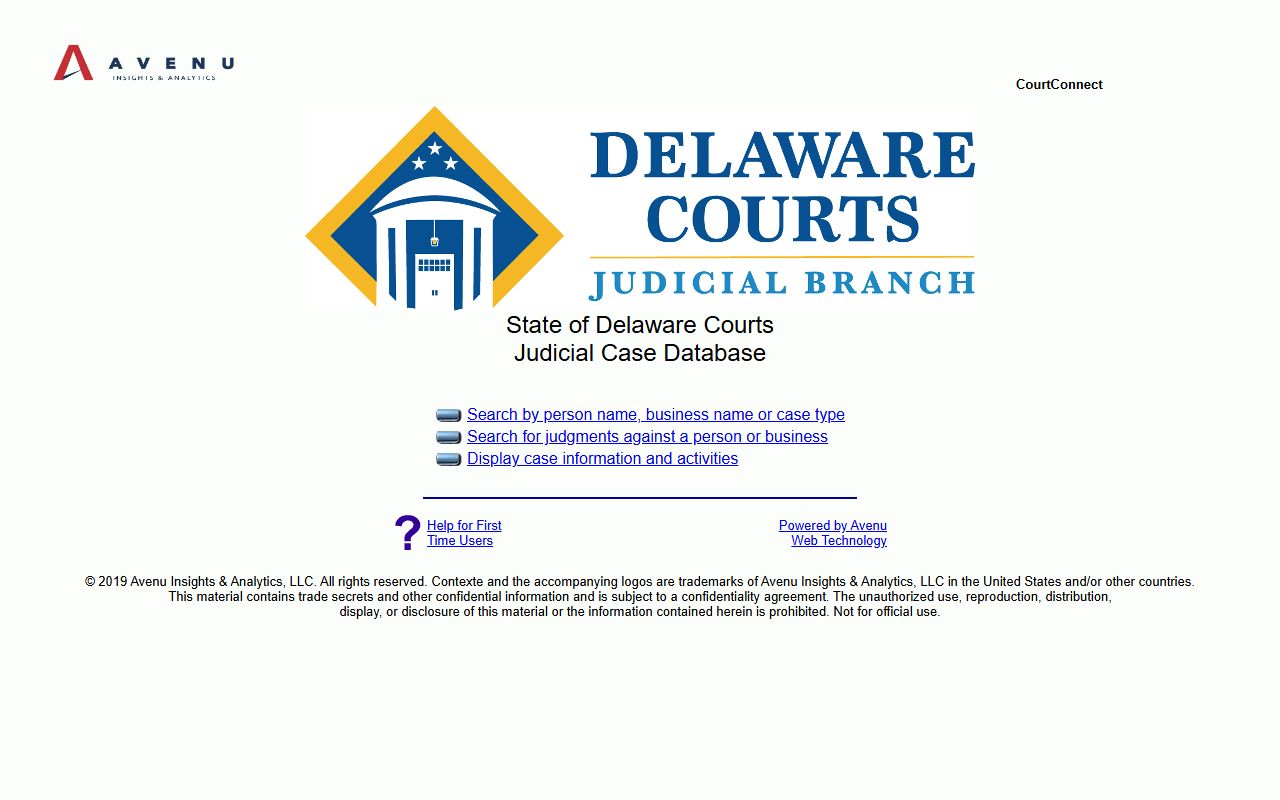
CourtConnect lets you look up civil traffic cases by party name, pull docket reports, and check case status for proceedings in JP Court, Court of Common Pleas, and Superior Court.
Traffic Ticket Records by Violation Type
Delaware divides traffic violations into three main categories based on severity. Felony traffic violations are the most serious and include vehicular assault in the first degree, vehicular homicide in the first and second degrees, third and subsequent DUI offenses, and eluding a police officer. These can lead to prison terms, heavy fines, and permanent loss of driving privileges. Felony traffic matters move to Superior Court rather than staying in the Justice of the Peace system.
Traffic misdemeanors fall in the middle tier. These are criminal road offenses that carry up to one year in jail and fines up to $5,000. Common examples include driving under the influence for first or second offense, reckless driving, passing a stopped school bus, and driving with a suspended license. Drivers cited for traffic misdemeanors generally must appear at Justice of the Peace Courts. Seat belt violations are also classified as traffic misdemeanors in Delaware, which surprises some drivers who expect a simpler fine structure.
Traffic infractions are the most common type. They are non-criminal offenses that make up the bulk of citations issued across the state each year. Speeding, failure to signal, illegal parking, improper U-turns, and using a hand-held phone while driving all fall into this category. Infractions don't carry jail time, but fines can still be significant once all the required fee assessments are added in.
Fines in Delaware include more than just the base amount listed on the ticket. Added to every fine are assessments for the Delaware Criminal Justice Information System Fund, the Victims Compensation Fund, the Ambulance Fund, the Transportation Trust Fund, and others. A speeding ticket for 9 mph over the limit may have a $29 statutory fine but total $110.50 after all required fees are applied. Base fines for minor violations typically start at $25, but the total is almost always higher.
Delaware traffic violations fall into three tiers: felonies, misdemeanors, and civil infractions. Which tier applies to your ticket determines which court handles the case and what penalties are on the table.
Understanding which category a violation falls into tells you which court will handle the case and what the range of outcomes could be.
The complete text of Delaware's traffic statutes is in Title 21 of the Delaware Code, which governs motor vehicle registration, operation, safety, and liability statewide.
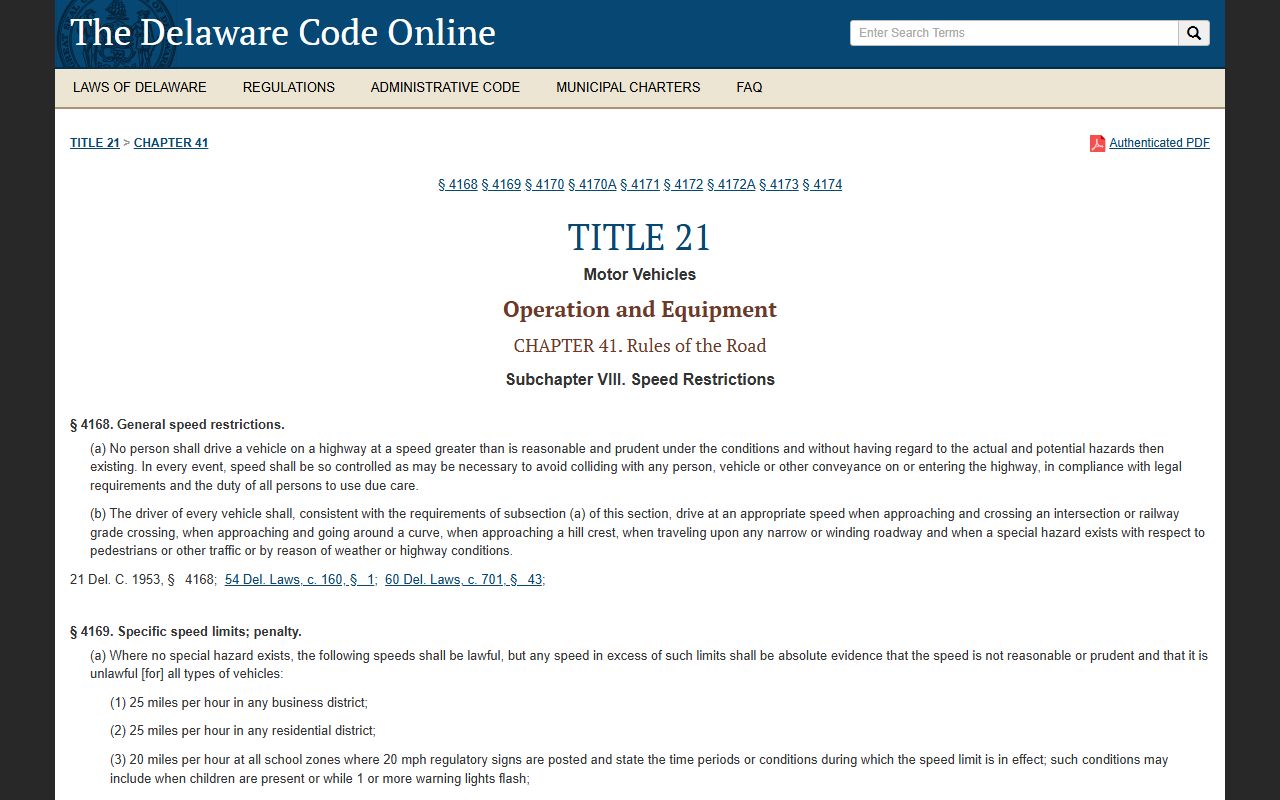
Title 21 is the primary legal source for all traffic-related offenses in Delaware and is available in full on the state's official code website at delcode.delaware.gov.
Speed Limits, Fines, and Reckless Driving Laws
Delaware speed limits are set in Title 21, § 4169. The specific limits are: 25 mph in any business district; 25 mph in any residential district; 20 mph in school zones where posted; 50 mph on two-lane roadways; and 55 mph on four-lane and divided roads. Drivers must also adjust speed to avoid collisions regardless of what the posted limit says, under the general speed restriction in § 4168. That rule applies even when you're technically under the posted limit.
Fines for speeding are structured by offense count and how far over the limit you were. A first offense carries a $20 base fine. A second offense within 24 months moves to $25. On top of those base fines, per-mile penalties apply. Exceeding the limit by more than 5 but less than 16 mph adds $1.00 per mile on a first offense and $2.00 per mile on a second. Going more than 19 mph over adds $3.00 per mile for a first offense and $4.00 for a second. These per-mile amounts come before the additional fee assessments that push the total higher.
Electronic speed cameras operate under a separate civil framework. A camera violation requires the vehicle to exceed the posted limit by at least 11 mph in a residential district or work zone. These violations are civil, not criminal. They don't go on your driving record and can't be used for insurance purposes. Court costs up to $35 may apply if you request a hearing and are found at fault.
Under § 4175, reckless driving means operating a vehicle in willful or wanton disregard for the safety of persons or property, or driving at 90 mph or more on a public road. First offense penalties include fines of $100 to $300, imprisonment of 10 to 30 days, or both. Aggressive driving under § 4175A covers committing three or more moving violations simultaneously or in rapid succession, including unsafe lane changes, tailgating, failing to yield, and running red lights or stop signs. Both charges create records that show up in JP Court case files.
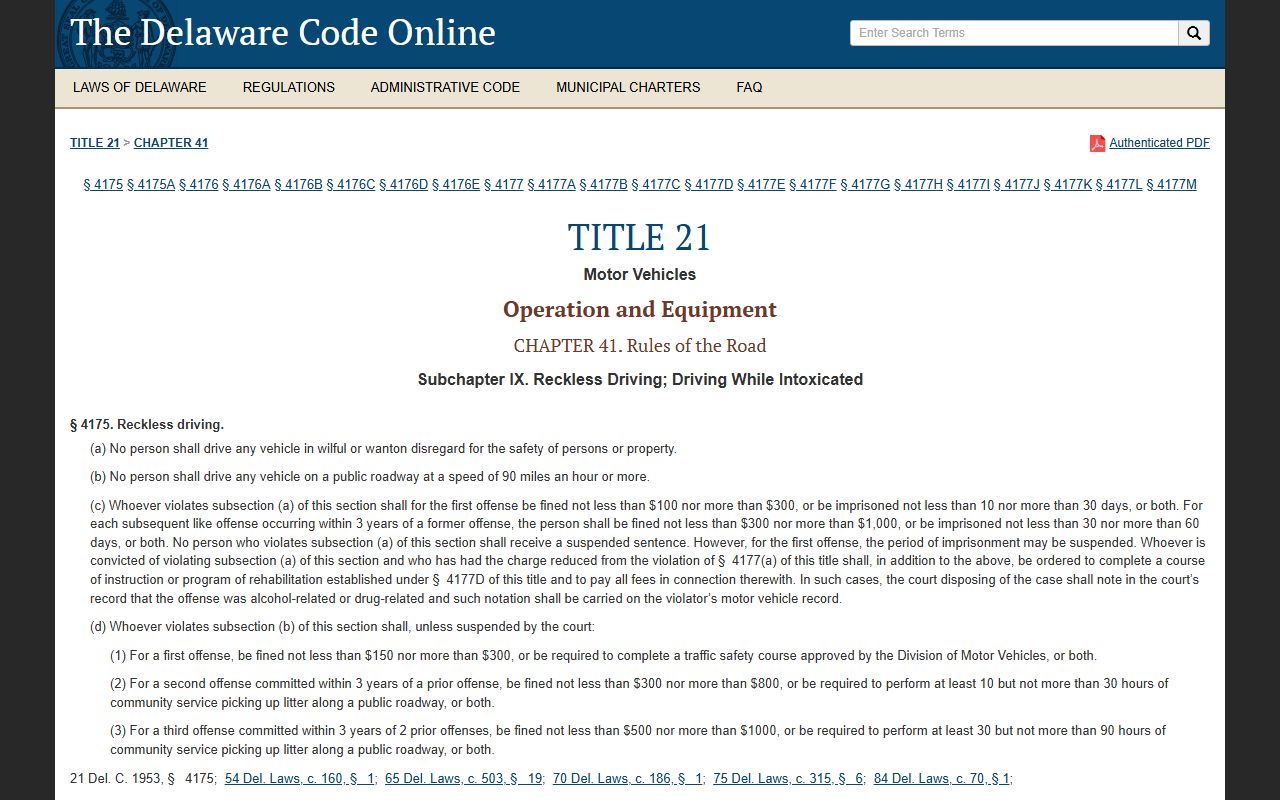
The reckless and aggressive driving statutes in Title 21 are available directly on the Delaware Code website, with the full text of each penalty provision.
Note: Driving 50 mph or more over the posted speed limit results in a mandatory one-year suspension under Delaware's extreme speeding rules, with no course substitution available for that level of violation.
DUI Violations and Traffic Records in Delaware
DUI records are part of Delaware's traffic court system and follow the same basic access rules as other traffic ticket records. A first DUI offense carries a fine of $500 to $1,500, a potential twelve-month jail term, and a 12 to 24-month license revocation. Drivers may also be ordered to install an ignition interlock device. Second offenses bring fines of $750 to $2,500, a minimum 60-day jail term, and revocation periods of 24 to 60 months. Third and subsequent DUI offenses are prosecuted as Class G felonies with fines up to $5,000 and prison terms of one to two years.
Under 21 Del. C. § 4177(d), habitual offenders can face Class C felony charges with fines up to $15,000 and imprisonment of 5 to 15 years. Delaware has a Zero Tolerance Law for minors. Drivers under 21 caught with any alcohol face a two-month license revocation on the first offense and mandatory participation in an alcohol treatment program. Commercial license holders face one-year revocation if caught driving with a BAC of .04 percent or higher. DWI offenses stay on a Delaware driving record for a minimum of five years. After any DUI suspension, license reinstatement requires applying for a new license, paying a $143.75 reinstatement fee, and retaking vision, written, and road tests. The Delaware Ignition Interlock Device Unit handles IID requirements and can be reached at (302) 744-2508.
DUI penalties in Delaware escalate sharply with each offense. First and second offenses are misdemeanors. Third and subsequent offenses become Class G felonies with prison time up to two years and fines up to $5,000.
License revocation periods grow with each successive DUI conviction, and reinstatement after any suspension requires paying the $143.75 fee and retaking all license tests.
Delaware Driving Records from the DMV
The Delaware Division of Motor Vehicles maintains driving records for every licensed driver in the state. Records come in three formats: 3-year history, 5-year history, or full history from your first license. All three cost $25.00 regardless of how you request them. Your record shows traffic violations, convictions, license status, and accident history. The effective date of the record is the date of purchase, and anything that happens after that date won't appear on a copy you already have.
Online requests go through the MyDMV portal at dmv.de.gov. To create an account, you need your Delaware driver's license number, date of birth, and the last four digits of your Social Security number. Payment accepts MasterCard or Visa. Records come as a PDF and require Adobe Acrobat Reader. You can reopen a record you purchased for up to 90 days after the purchase date. Mail requests use the Personal Information Release Form MV703, which must be notarized with a seal or stamp. Mail the completed form with a $25 check or money order to: Division of Motor Vehicles, ATTN: Driver License Administration, P.O. Box 698, Dover, DE 19903. In-person requests at any DMV office are also available and are typically provided on the spot. For help with any of these options, call the DMV at 1-877-477-7117.
The MyDMV driving records FAQ answers common questions about what appears on a record and which format is right for different purposes.
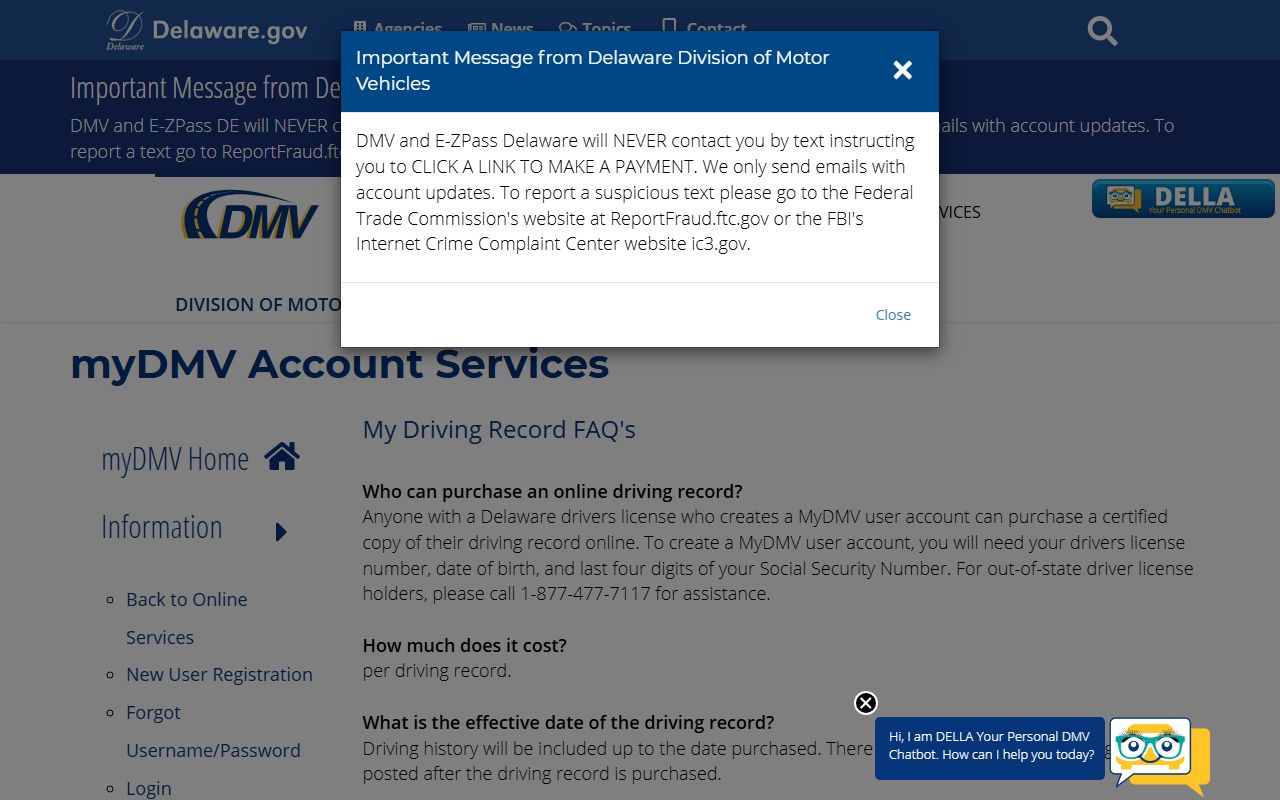
The FAQ explains the difference between the three record types and walks through what information is included in each version.
The DMV driving records request page covers each method for getting a copy of your driving record in Delaware.
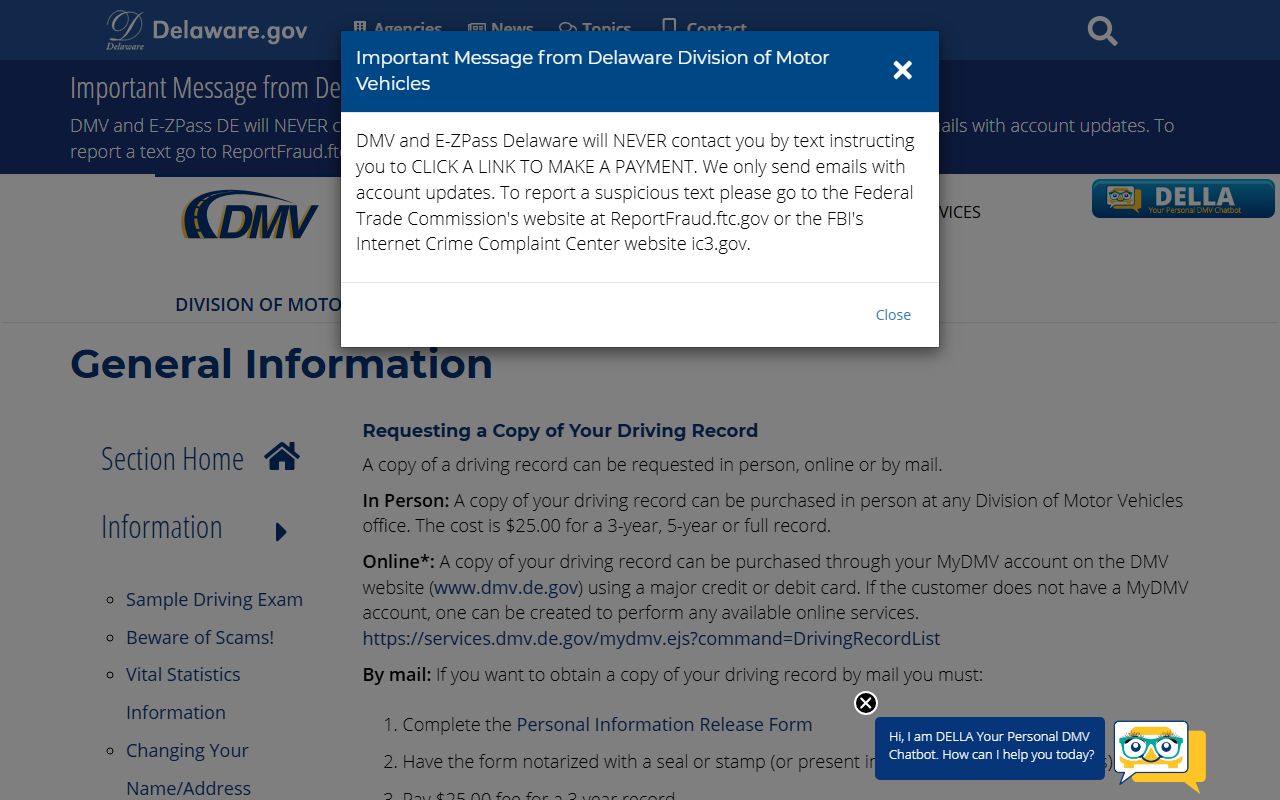
Whether you request online, by mail, or in person, the $25 fee is the same for all record types and all request methods.
The MyDMV account services page explains how to set up your account and manage all your DMV needs in one place.
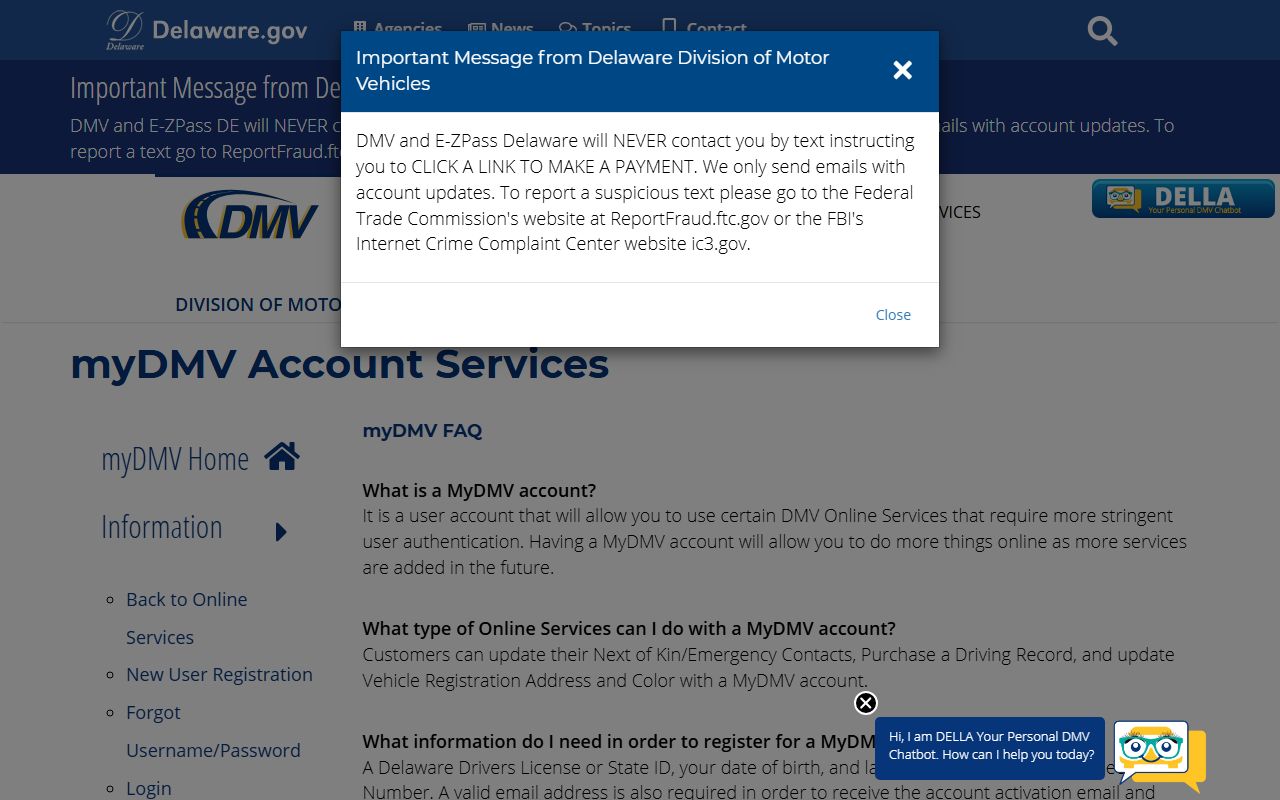
A MyDMV account also lets you renew your license, check registration status, and access other driver services without visiting an office in person.
Paying Delaware Traffic Ticket Fines
Your Delaware traffic ticket will say whether it is a voluntary assessment or a mandatory appearance ticket. Voluntary assessment means you can pay without going to court. Mandatory appearance means you must show up in person on the date listed. If the ticket has no dollar amount, it's a mandatory appearance ticket. Fail to appear and you risk a driving privilege suspension and an arrest warrant.
For voluntary assessment tickets, you can pay online through the DELJIS ePayment portal. Enter your case number or ticket number, then enter your last name as it appears on the ticket. The system accepts MasterCard, Visa, and Discover. Prepaid cards with per-use surcharges are not accepted. The State of Delaware does not keep your payment information beyond 24 hours after the transaction. Some courts charge a small fee for online payments. Check the "View Participating Courts" link on the portal to confirm your court accepts online payment before you try.
You can also pay by phone at (302) 739-6911, Monday through Friday, 8:00 AM to 4:00 PM, or by fax at (302) 739-7590. Mail payments go to: State of Delaware, Voluntary Assessment Center, P.O. Box 7039, Dover, DE 19903. Make checks payable to "State of Delaware" and include a copy of your ticket. In-person payments are accepted at any Justice of the Peace Criminal Court location and at kiosks that take cash, credit, or debit. If you can't pay the full amount, call (302) 739-6911 to ask about a payment plan. You have 30 days from the ticket issue date to set up a six-payment plan through courtpay.delaware.gov by selecting "Deferred Amount."
If you miss the payment deadline, your driving privilege can be suspended and a warrant may be issued. Contact the Voluntary Assessment Center at (302) 739-6911 as soon as possible if you need help with a missed deadline.
To contest a voluntary assessment ticket, do not pay it. Instead, show up at the court on the date listed and request a hearing. Paying the fine is treated as an admission of guilt.
The DELJIS ePayment portal is available around the clock and is the fastest way to handle a voluntary assessment fine without calling or visiting a court.
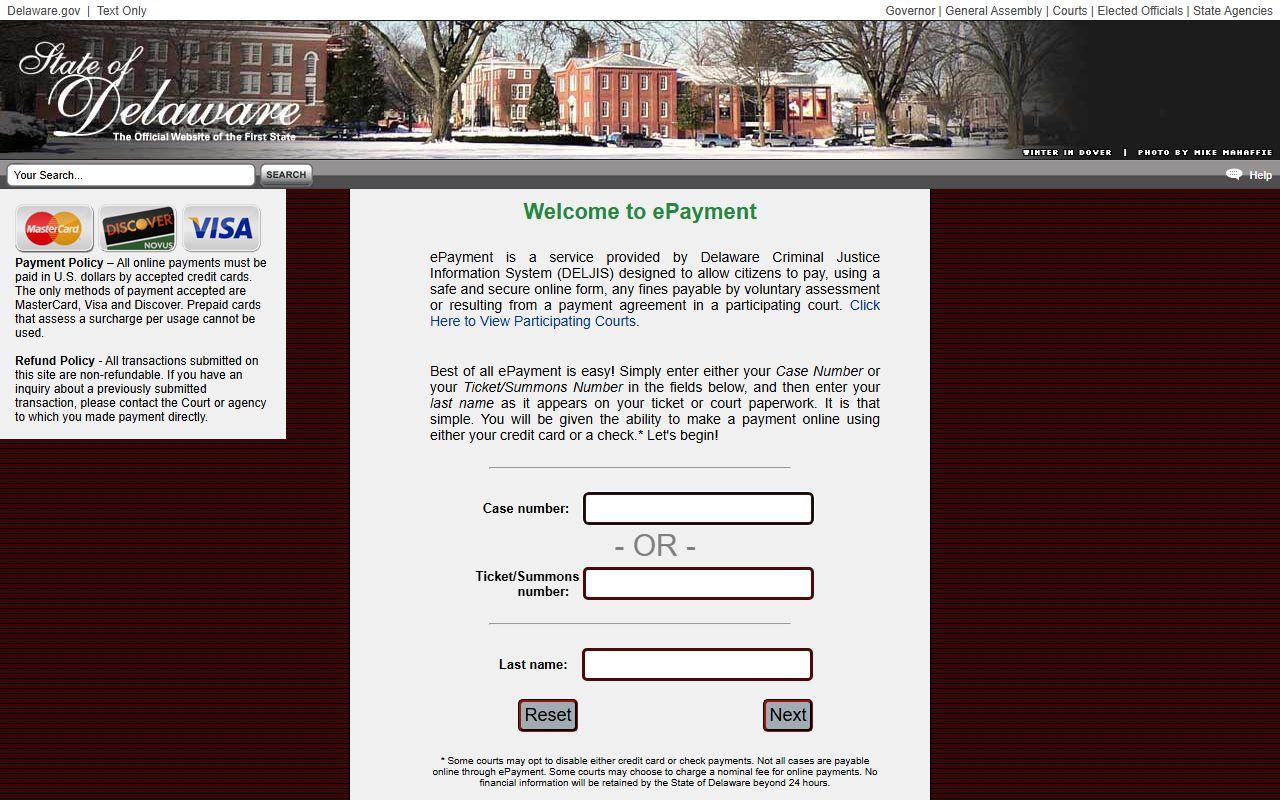
The portal also lets you check the status of a payment you already submitted and see which courts are enrolled in the online payment program.
Note: Paying a voluntary assessment ticket for speeding under 14 mph over the limit may prevent demerit points from being assessed, provided you have no speeding convictions in the past three years and hold a Class D license rather than a CDL.
Points and Driver Records in Delaware
Delaware uses a point system to track driving behavior through the DMV. Points stay on your record at full value for 12 months from the date of the violation. During the following 12 months, they count at half value. DWI convictions stay on record for a minimum of five years regardless of points. Point values for common violations: 2 points for speeding 1 to 9 mph over; 4 points for speeding 10 to 14 mph over; 5 points for speeding 15 to 19 mph over; 6 points for reckless driving, aggressive driving, or passing a stopped school bus; and 3 points for disregarding a stop sign or red light.
The Driver Improvement Program sets thresholds that trigger action. At 8 points, you get an advisory letter. At 12 points, you must complete a behavior modification course within 90 days or face a two-month license suspension. Points above 12 lead to progressively longer suspensions: 14 points triggers four months off, 16 points six months, 20 points ten months, and 22 points a full year. Driving 50 mph or more over any posted speed limit results in a mandatory one-year suspension. To get your license back after that, you must have completed a behavior modification course within the previous two years.
An approved defensive driving course provides a three-point credit. It applies to future violations only and doesn't reduce points that are already on your record for insurance or employment purposes. The course credit remains valid for three years from completion. A speeding violation of 1 to 14 mph over the limit won't be assessed points if it's your first within any three-year period and you pay through the Voluntary Assessment Center or by online payment. This option is only available for Class D license holders, not CDL holders.
The Driver Improvement Program page at the DMV outlines the full suspension schedule and how to enroll in a required course.
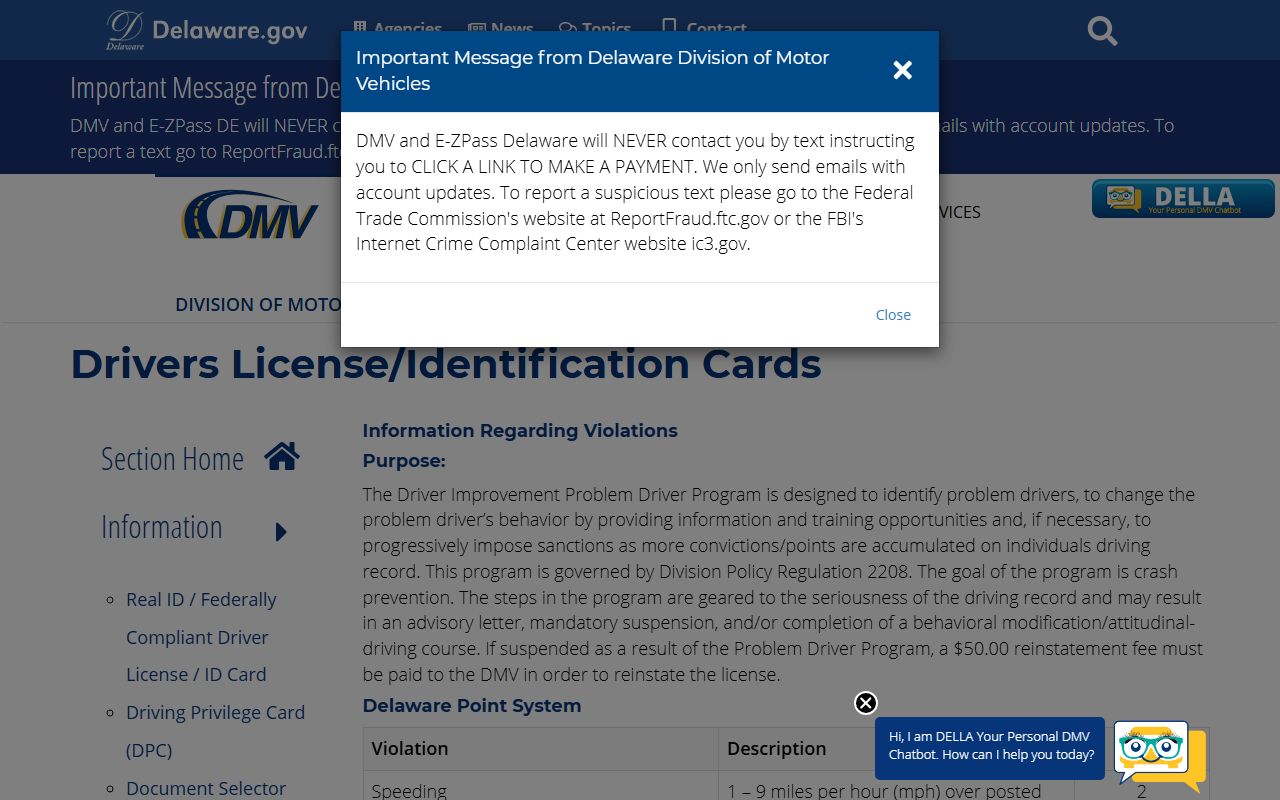
The page also explains what advisory letters mean and the steps you need to take before a pending suspension goes into effect.
Delaware State Police and Traffic Enforcement
The Delaware State Police Traffic Operations Section is responsible for coordinating statewide traffic enforcement, maintaining crash records, and running the Commercial Vehicle Enforcement Unit. If you need a crash report, all requests must be submitted by mail. Walk-in requests at the Dover office are not honored. Send your request with a copy of your collision information exchange form and a check or money order payable to the Delaware State Police to: Delaware State Police, Traffic Operations Section, P.O. Box 430, Dover, DE 19903. Standard crash report fees are $25.00. Fatal collision reports cost $60.00.
For questions about crash reports, call (302) 739-5931, Monday through Friday, 8:00 AM to 4:00 PM. For questions about a traffic ticket, contact the Voluntary Assessment Center at (302) 739-6911. The State Police also operate commercial vehicle scale houses in Townsend at 4580 N. DuPont Highway and in Middletown at 1280 Middletown Warwick Road. Tips about unsafe or overweight trucks can be reported by calling (302) 378-5230.
The Delaware State Police traffic unit page provides details on all Traffic Operations Section functions, including how to request crash records.
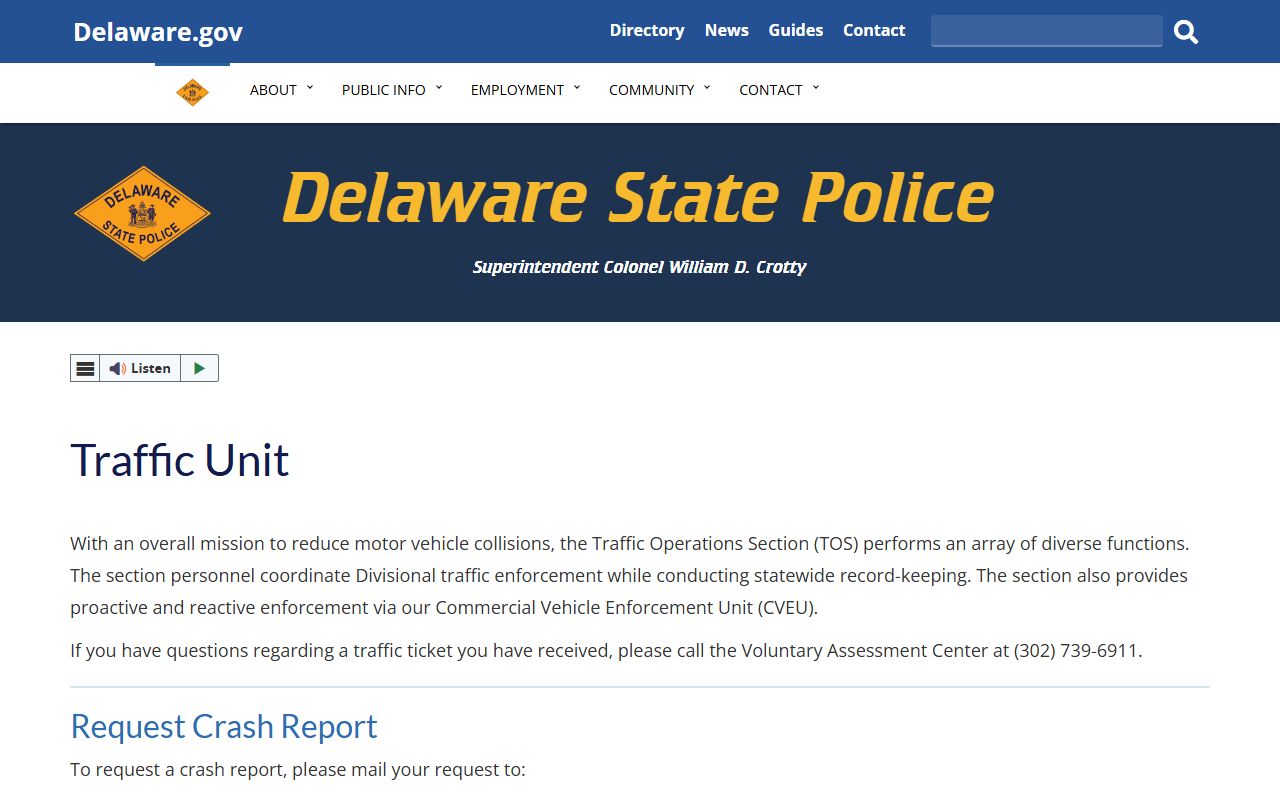
The page also lists contact information for the commercial vehicle unit and the process for reporting overweight or unsafe trucks on Delaware highways.
Browse Delaware Traffic Records by County
Delaware has three counties, each with its own court network handling traffic violations. Select a county below to find court contact information, local procedures, and resources for traffic ticket records in that area.
Delaware Traffic Ticket Records by City
Select a city below to find local court information, payment options, and specific resources for traffic ticket records in that community.